
The Norwood Scale: 7 Stages of Hair Loss (with Grafts & Cost)
Overview: The Norwood scale (or Hamilton-Norwood scale) is the leading classification system for male pattern baldness, divided into 7 primary stages. This guide maps each of the 7 stages to a realistic surgical graft range (from 0 to 6,500+) and typical cost, helping you plan your hair restoration effectively.
What Is the Norwood Scale?
The Hamilton-Norwood scale is the universally accepted medical standard used to measure the severity of androgenetic alopecia (male pattern baldness). Originally developed by Dr. James Hamilton in the 1950s, the scale was later refined and expanded by Dr. O'Tar Norwood in the 1970s.
Surgeons use this 7-stage classification system to assess the progression of hair loss, determine if a patient is a viable candidate for a hair transplant, and calculate the approximate number of grafts required to restore a natural-looking hairline and crown density.
The Norwood Scale Chart: All 7 Stages
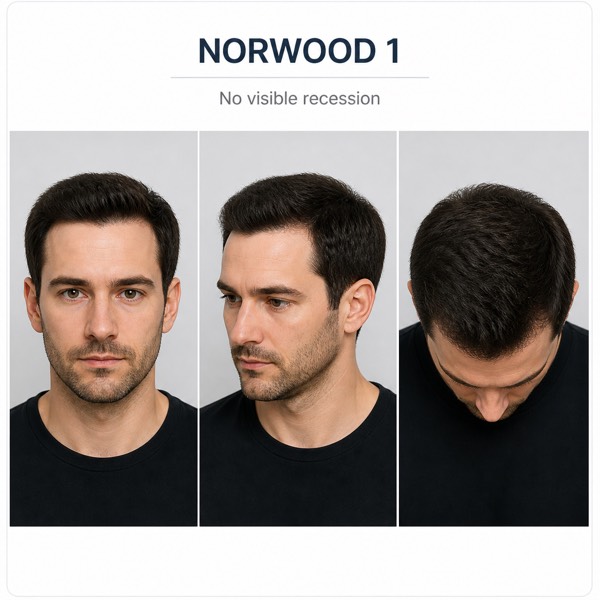
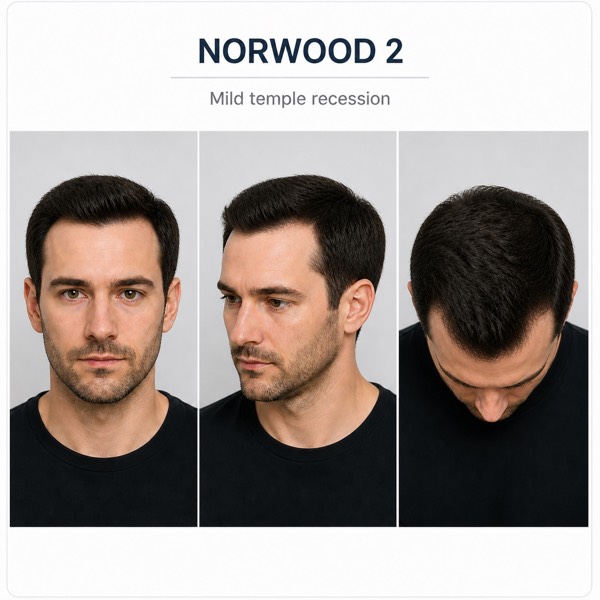
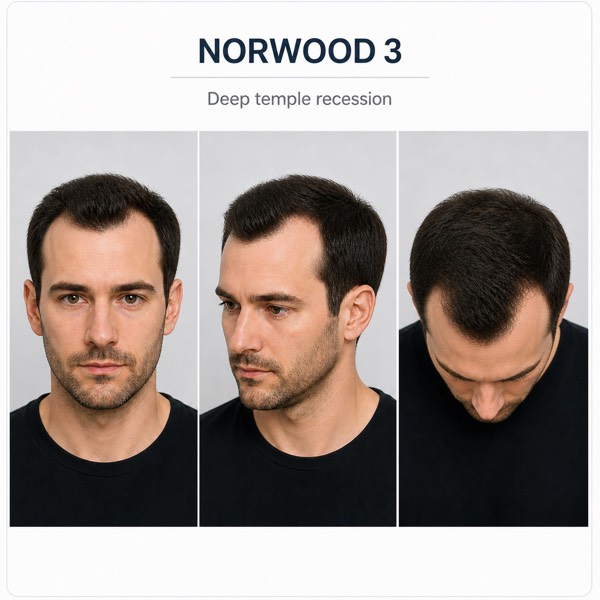
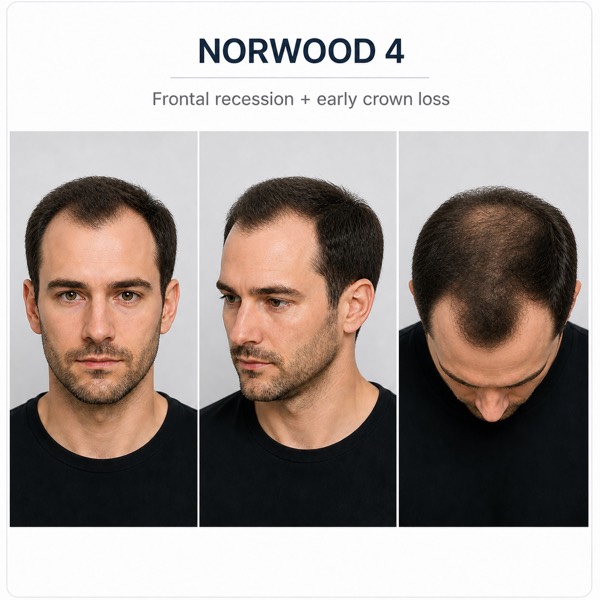
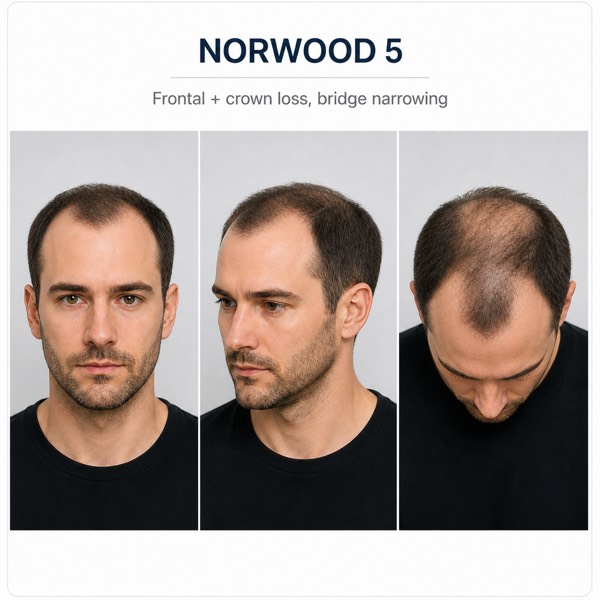
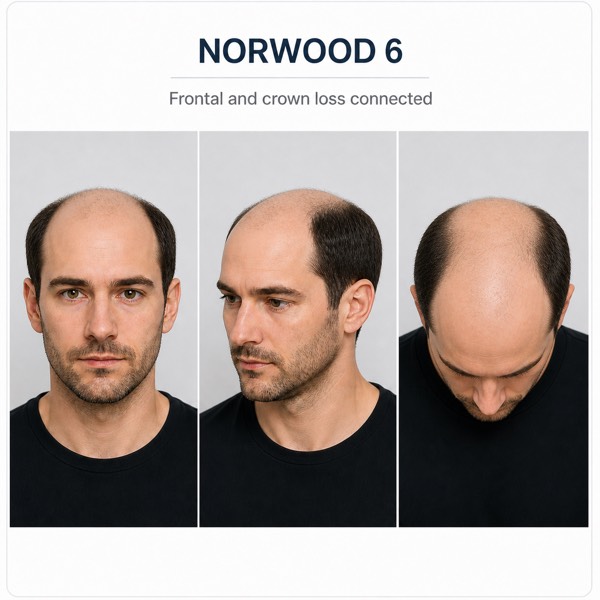
Review the illustrations below to identify your current stage, baseline graft estimate, and treatment options.

How Many Grafts Does Each Stage Need?
| Stage | Clinical Description | Estimated Grafts | Cost Estimate |
|---|---|---|---|
| Norwood 1 | Juvenile hairline. No loss. | 0 | Calculate → |
| Norwood 2 | Mild temple recession. | 1,500 – 2,000 | Calculate → |
| Norwood 3 | Deep "M" or "U" shaped recession. | 2,000 – 2,500 | Calculate → |
| Norwood 4 | Severe recession + vertex balding. | 2,500 – 3,500 | Calculate → |
| Norwood 5 | Bridging hair band narrows greatly. | 3,500 – 4,500 | Calculate → |
| Norwood 6 | Frontal and vertex regions merge. | 4,500 – 5,500 | Calculate → |
| Norwood 7 | Only horseshoe pattern remains. | 5,500 – 6,500+ | Calculate → |
How Much Does Treatment Cost at Each Stage?
Total surgical cost is typically calculated using the formula: Number of Grafts × Price Per Graft. However, the price-per-graft varies wildly depending on your country and the clinic's prestige.
- USA: Clinics typically charge between $4.50 and $8.50 per graft.
- UK: Clinics generally charge between £3.50 and £6.00 per graft.
- Turkey: Rather than per-graft pricing, Turkish clinics usually offer all-inclusive packages. These packages typically range between $2,800 and $4,500.
For a detailed global breakdown, see our Turkey vs USA and Turkey vs UK cost comparisons, or consult our ranking of the best countries for a hair transplant. To estimate what your stage costs, use our intelligent Cost Calculator.
Norwood Scale Type A Variants
While the standard Norwood scale features simultaneous hairline recession and crown thinning, approximately 15–20% of men experience a "Type A" progression.
In the Norwood Type A variants (e.g., 2A, 3A, 4A, 5A), hair loss progresses uniformly from the front hairline backward to the crown, without an isolated bald spot forming in the vertex. For a detailed breakdown of these unique patterns, see our guide on Norwood Scale Type A.
How to Identify Your Norwood Stage
Identifying your stage requires checking two specific areas: the depth of recession at your temples and the density of hair at your crown (vertex). However, accurately self-diagnosing can be difficult due to mirror angles and subjective bias.
To get a clinically accurate assessment, you can upload clear, well-lit photos of your scalp (front, top, and back) into our AI-driven analyzer. Our system instantly identifies your Norwood stage and maps out your donor capacity requirements.
Frequently Asked Questions
How do I read the Norwood scale? +
The Norwood scale is read by comparing your hairline and crown to the 7 reference stages. It progresses from stage 1 (no loss) to stage 7 (severe baldness, leaving only a horseshoe pattern).
Which Norwood stage am I at? +
To determine your stage, look at the degree of recession at your temples and thinning at your vertex. For a precise estimate, use our AI photo analyzer.
Which Norwood stage is most common? +
Norwood 3 is the most common stage where men actively start seeking hair restoration, as it marks the beginning of clinically significant hair loss.
At what Norwood stage should I consider a hair transplant? +
Most surgeons recommend considering a transplant starting at Norwood 3, once your hair loss has stabilized, to ensure sufficient donor capacity for a dense result.
Can the Norwood scale be reversed with treatment? +
Medical treatments like Minoxidil and Finasteride can halt progression and sometimes reverse early miniaturization, but significant hair loss typically requires a transplant to restore.
What's the difference between the Hamilton-Norwood scale and the Ludwig scale (women)? +
The Norwood scale measures male pattern baldness, which typically recedes at the temples and crown. The Ludwig scale measures female pattern hair loss, which presents as diffuse thinning across the top of the scalp without receding the frontal hairline.
How quickly does hair loss progress through the stages? +
Progression speed varies highly based on genetics and age. Some men take decades to go from Stage 2 to Stage 6, while others experience rapid loss over just a few years.
How many grafts and what cost should I expect at my stage? +
Grafts vary drastically: Norwood 3 often needs ~2,000 grafts, while Norwood 6 may need 5,000+. Costs correlate directly with grafts and clinic location. Use our cost calculator for accurate estimates.
References:
1. Norwood, O. T. (1975). Male pattern baldness: classification and incidence. Southern Medical Journal.
2. Hamilton, J. B. (1951). Patterned loss of hair in man: types and incidence. Annals of the New York Academy of Sciences.
Next Step: Your Personalized Analysis
Upload your photos, get an expert graft estimate, compare global costs, and preview your transformation — all in just 30 seconds.
Start My Free Analysis →