
In Norwood Stage 5, the band of hair separating the frontal baldness from the vertex bald spot narrows significantly and begins to thin out. The overall area of hair loss is much larger. Achieving a cosmetically satisfying result usually requires 3,500 to 4,500 grafts, and donor supply management becomes critical.
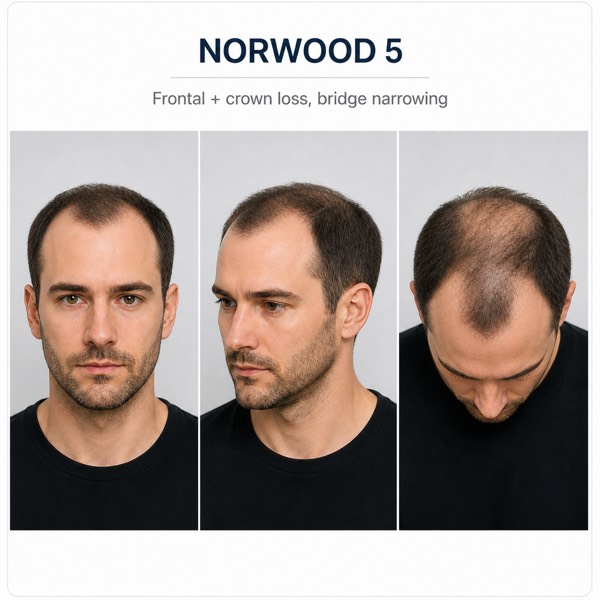
The frontal baldness and the crown bald spot are still technically separate, but the 'bridge' of hair between them is sparse, narrow, and clearly failing. The hair loss on both the front and the crown has expanded in surface area compared to Stage 4.
Because the balding area is extensive, there is rarely enough donor hair to create maximum density everywhere. Surgeons must be strategic. They often prioritize restoring the frontal hairline to frame the face properly, leaving the crown slightly thinner to conserve grafts. You can check your potential reserves using our Donor Capacity Estimator.
Depending on your scalp laxity, donor density, and the clinic's capabilities, addressing a Stage 5 may require two separate hair transplant surgeries spaced 10 to 12 months apart. This ensures high graft survival rates and prevents over-harvesting the donor area in a single massive session.
In the Norwood 5A variant, the hairline has receded all the way back to the vertex without leaving any bridge, but the sides remain relatively high.
The narrow bridge will eventually vanish completely, merging the front and crown into one massive bald area, transitioning the patient into Norwood Stage 6.
3,500 – 4,500 Grafts
Covering the extensive loss of Stage 5 requires a large 'mega-session' of 3,500 to 4,500 grafts. This pushes the limits of what can be safely extracted via FUE in a single day. Read our comprehensive guide on How Many Grafts Do I Need? for more details on calculating your specific requirements.
The total cost of your hair transplant depends entirely on the clinic's location and pricing structure (per-graft vs all-inclusive package).
For a detailed global breakdown, see our Turkey vs USA and Turkey vs UK comparisons.
Surgery is the only way to restore coverage. However, the surgeon will focus on creating an 'illusion of density' by shingling the hair, rather than true juvenile density. Medical therapies are crucial to keep the remaining hair on the sides and back strong.
Yes, but success depends heavily on the density of your donor area (the back of your head). If your donor hair is thin, you may not have enough grafts for full coverage.
Typically between 3,500 and 4,500 grafts are required to provide adequate coverage across both the front and the crown.
It will provide excellent coverage and frame your face, but it will not be as thick as the hair you had when you were 18. The density will be purposefully lighter, especially on the crown.
Many top-tier clinics prefer to do the front in session one (approx. 2,500 grafts) and the crown in session two (approx. 1,500 grafts) a year later to maximize graft survival.
Upload your photos, get an expert graft estimate, compare global costs, and preview your transformation — all in just 30 seconds.
Start My Free Analysis →