
Norwood Stage 3 is considered the first official stage of clinical balding. It features deep, symmetrical recession at the temples that is fully visible to the naked eye. The vertex (crown) remains unaffected. Restoring the hairline at this stage typically requires between 2,000 and 2,500 grafts.
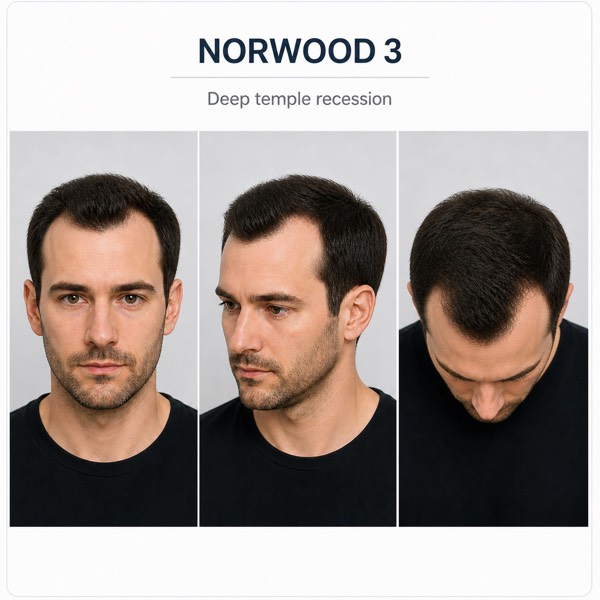
The hairline has receded deeply at the temples, forming a very distinct 'M', 'V', or 'U' shape. The recession goes further back than a mature hairline, and the hair in the receding zones is often miniaturized (thinner and lighter). The crown remains full.
Stage 3 is the most common decision point for hair transplants. Because the hair loss is now undeniably visible and affects facial framing, many men seek surgery. It is an excellent time for a transplant, provided that the hair loss has stabilized and the patient understands the need for long-term preventative care.
It is critical not to confuse standard Norwood 3 with the 3-Vertex variant. Standard Stage 3 is strictly frontal recession. Norwood 3 Vertex involves the same frontal recession but includes early thinning or a distinct bald spot at the crown. They require entirely different surgical planning and graft distributions.
For some men, the Norwood 3A variant occurs, where the entire frontal hairline recedes uniformly backwards without leaving an island of hair in the middle.
Without medical intervention, Stage 3 usually progresses to Stage 4, where the frontal recession deepens further and a bald spot begins to form separately on the crown.
2,000 – 2,500 Grafts
Restoring a Norwood Stage 3 requires rebuilding the deep temporal recessions and reinforcing the frontal band. This typically requires 2,000 to 2,500 grafts to achieve natural, convincing density. Read our comprehensive guide on How Many Grafts Do I Need? for more details on calculating your specific requirements.
The total cost of your hair transplant depends entirely on the clinic's location and pricing structure (per-graft vs all-inclusive package).
For a detailed global breakdown, see our Turkey vs USA and Turkey vs UK comparisons.
A combination approach is highly effective. A hair transplant permanently restores the receded hairline, while FDA-approved medications (Finasteride/Minoxidil) are essential to prevent the native hair behind the transplant from falling out in the future.
Yes, Norwood 3 is generally considered the stage where hair loss becomes obvious to others, as the deep temple recession alters the framing of the face.
No. Once hair follicles have died and the scalp is smooth, natural remedies cannot bring them back. Only a surgical hair transplant can restore hair to those areas.
Most patients require between 2,000 and 2,500 grafts to adequately fill the deep temporal recessions.
Norwood 3 involves only frontal recession. Norwood 4 involves even deeper frontal recession PLUS a distinct bald spot on the crown, separated by a band of hair.
Upload your photos, get an expert graft estimate, compare global costs, and preview your transformation — all in just 30 seconds.
Start My Free Analysis →