
What Does 3000 Grafts Look Like?
A 3,000 graft session is a substantial procedure, typically reserved for patients with more advanced hair loss at Norwood Stage 3 or 4. Going well beyond a simple hairline touch-up, it provides enough follicular units to completely rebuild the frontal third and add significant density to the mid-scalp[2].
At the graft densities most surgeons use, 3,000 grafts covers roughly 75–85 cm² — a large portion of the scalp. Hair restoration doesn't replicate original density (80–120 units/cm²). Instead, a density of 30–50 units/cm² is used to create a natural-looking illusion of fullness[2].
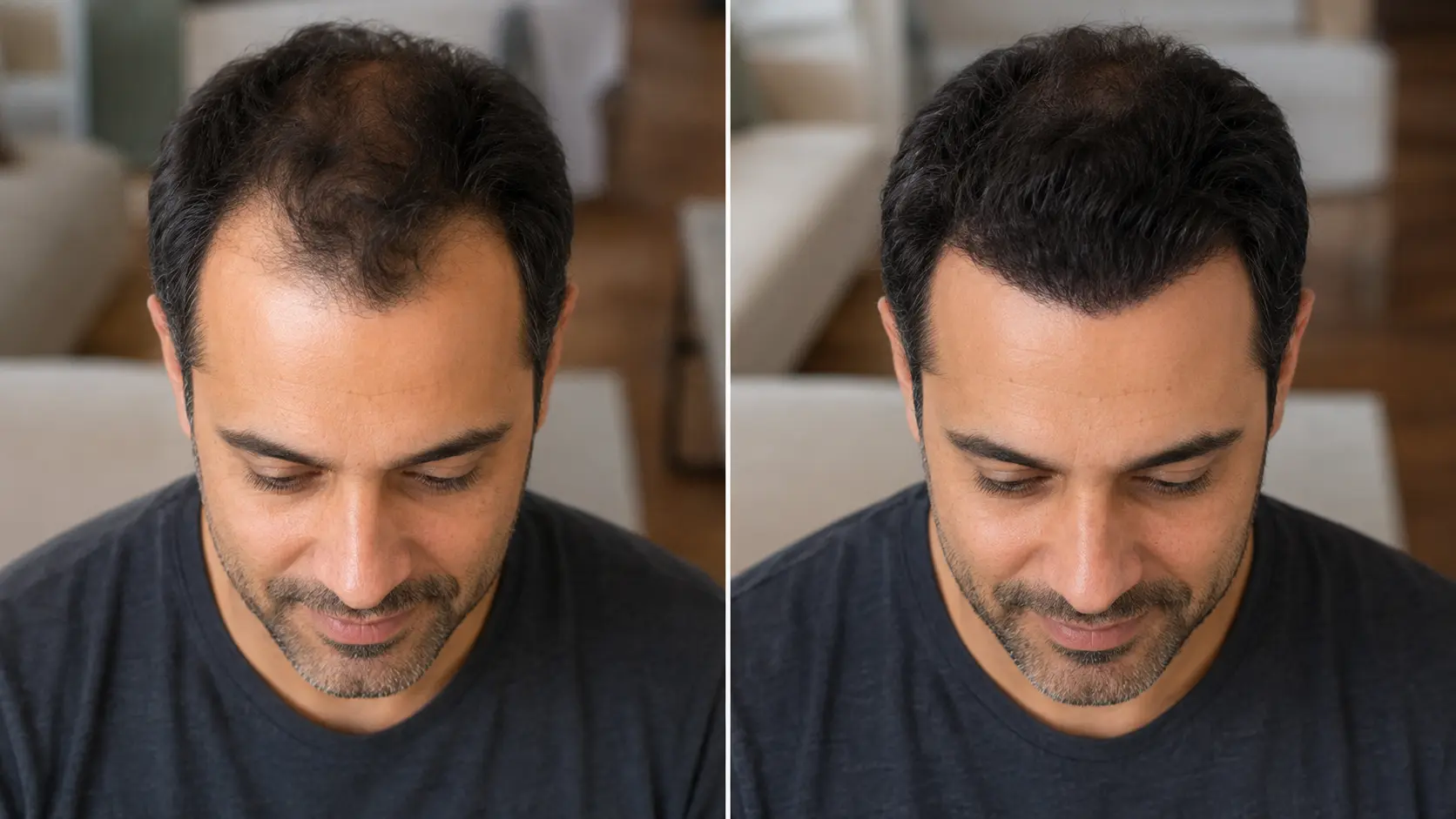
The limit isn't the graft count itself — it's the area you spread it over. Stretched across a Norwood 5 pattern, the same 3,000 grafts fall below the density threshold needed for a natural result[4], which is why surgeons recommend a 4,000 graft session at that stage.
Not Sure if 3,000 Grafts is Enough?
Unsure if you need 3,000 grafts? Upload two photos, and our calculator will instantly estimate your target graft range and global pricing.
Calculate Your Grafts NowAverage Cost of 3000 Grafts by Country
Geographic location dictates the cost of a 3,000 graft procedure. Western clinics usually bill per graft, while medical tourism hubs offer all-inclusive packages.
| Country | Pricing Model | Estimated Cost (USD) | Full Guide |
|---|---|---|---|
| 🇺🇸 United States | Per Graft | $11,000 – $19,000 | View prices → |
| 🇬🇧 United Kingdom | Per Graft | $9,500 – $16,500 | View prices → |
| 🇩🇪 Germany | Per Graft | $7,000 – $11,000 | — |
| 🇵🇱 Poland | Per Graft | $6,000 – $9,000 | — |
| 🇹🇭 Thailand | Package Price | $4,000 – $8,500 | View clinics → |
| 🇲🇽 Mexico | Package Price | $6,500 – $8,000 | View clinics → |
| 🇹🇷 Turkey | Package Price | $2,800 – $4,500 | View prices → |
*Package prices typically include accommodation and VIP transfers.
Procedure Details
Surgery Duration: A 3,000 graft procedure is a full-day session, typically taking between 6 to 8 hours depending on the technique used.
FUE vs DHI: For 3,000 grafts, both techniques are highly effective (explore our FUE vs DHI comparison). DHI offers precise control for the hairline, while FUE efficiently covers broader mid-scalp areas.
Frequently Asked Questions
How many hairs is 3000 grafts? +
A single graft (follicular unit) is a naturally occurring group of 1 to 4 hairs. Across a full session this averages out to just over two hairs per graft, so a 3,000 graft procedure delivers approximately 6,000 to 6,900 hairs — the specific figure varies by individual donor density and ethnicity[3].
Is 3000 grafts enough for me? +
If you have moderate hair loss (Norwood 3 or 4) and need to restore your frontal hairline and mid-scalp, 3,000 grafts is usually sufficient. However, if your hair loss extends to the crown, you may need a larger session. Check our guide on how many grafts you need for a deeper breakdown.
Can 3000 grafts cover a bald crown? +
3,000 grafts can provide good coverage for the crown, but if you also have a receded hairline, you will have to prioritize. Covering both the front and a large bald crown typically requires 4,000 to 5,000+ grafts across two sessions.
Can 3,000 grafts be done in a single day, or is it split into two? +
Yes, it is typically completed in a single 6 to 8-hour session by an experienced medical team.
How much of my donor area does 3,000 grafts use? +
It utilizes a significant portion of the safe donor zone. A skilled surgeon will extract evenly so your back won't look visibly thinned.
How much area does 3000 grafts cover? +
At typical densities, 3,000 grafts covers roughly 75–85 cm² — enough to rebuild the frontal third of the scalp and add meaningful density through the mid-scalp[2].
Sources & References
[1] International Society of Hair Restoration Surgery (ISHRS). 2024 Practice Census Results.
[2] Unger, W. P., & Shapiro, R. (2004). Hair Transplantation (4th ed.). Marcel Dekker.
[3] Jimenez, F., & Ruifernández, J. M. (1999). Distribution of human hair in follicular units: a mathematical model for estimating the donor size in follicular unit transplantation. Dermatologic Surgery, 25(4), 294–298.
[4] Marritt, E. (1999). The death of the density debate. Dermatologic Surgery, 25(8), 654-660.