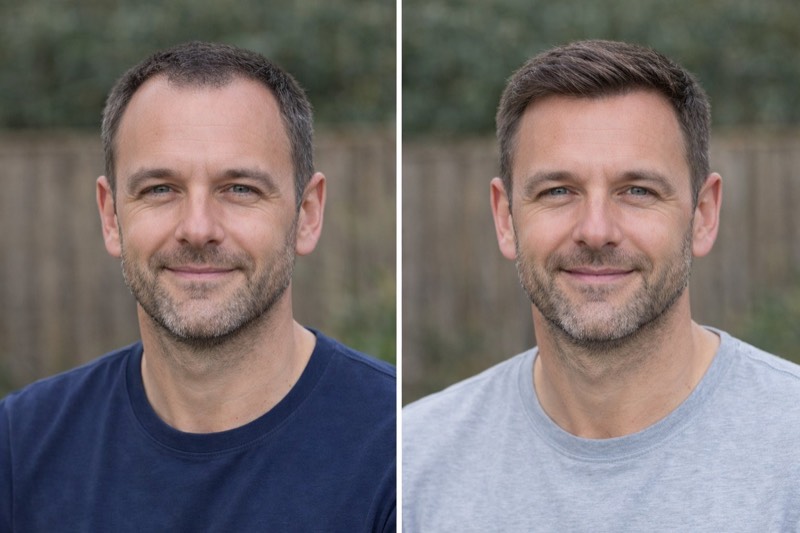
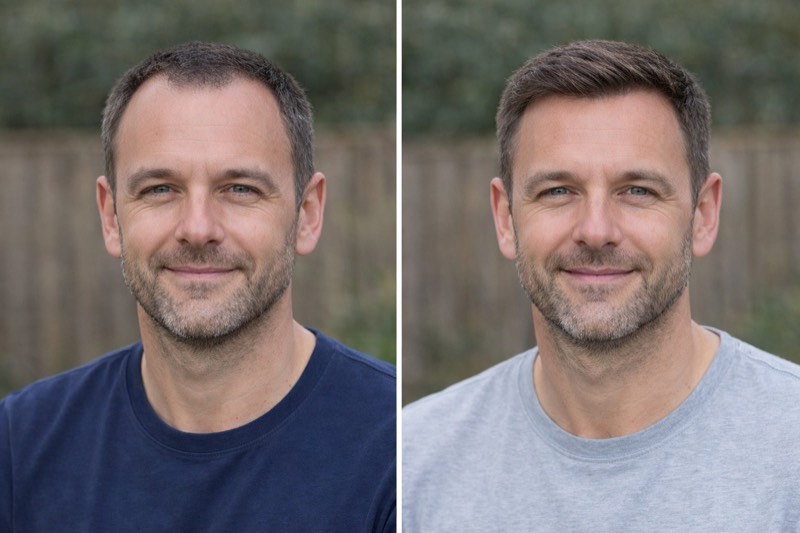
Upload your photos, get an expert graft estimate, compare global costs — in just 30 seconds.
Start My Graft AnalysisFour steps to a clinical estimate and a personalised result preview.
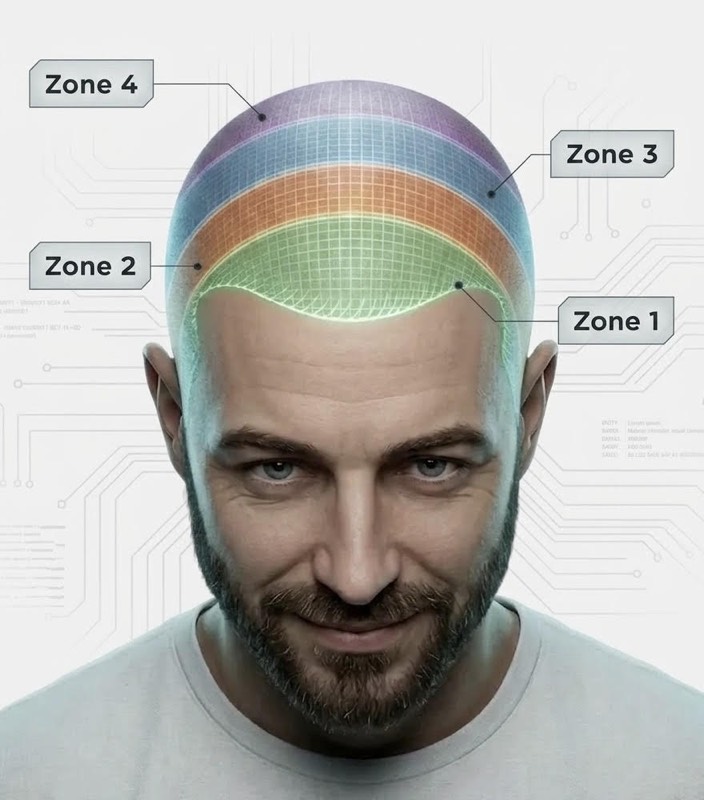
Graft requirements are calculated based on the target density and the specific surface area of each anatomical zone.
| Zone | Description | Regional | Cumulative Total |
|---|---|---|---|
| Zone 1 | Frontal Hairline (NW 2) | 1,700 – 2,100 | 1,700 – 2,100 |
| Zone 2 | Mid-Scalp Anterior (NW 3) | 400 – 600 | 2,300 – 2,700 |
| Zone 3 | Mid-Scalp Posterior (NW 4) | 700 – 800 | 3,000 – 3,500 |
| Zone 4 | Crown / Vertex (NW 5–7) * Range varies based on crown progression and donor capacity. | 1,000 – 3,000 | 4,000 – 6,500 |
For a precise analysis including your hair thickness, texture and hair loss activity:
Calculate My Specific NeedsThese prices represent the national average for a standard 3,000 graft (Norwood 4) procedure. Costs include surgeon fees but may vary significantly based on clinic reputation and exact technique.
These are just averages. Find out exactly how many grafts you need and get a personalized estimate in 30 seconds.
Calculate My Personalized CostBoth FUE and DHI are proven techniques that deliver natural-looking results. The right choice depends on your specific hair loss pattern, donor area, and surgical goals.
Individual follicular units are extracted from the donor area using a micro-punch tool. Recipient channels are then opened with a sapphire or steel blade, and grafts are implanted in a separate step. A well-established technique with an extensive clinical track record.
Extracted grafts are loaded directly into a Choi implanter pen and placed into the scalp in a single step — no pre-made channels required. This simultaneous approach minimises graft handling time and allows more controlled placement depth and angle.
| Criteria | FUE | DHI |
|---|---|---|
| Recipient Site Creation | Sapphire or Steel Blade | Choi Implanter Pen |
| Implantation Method | Two-Step (Channel + Implant) | Single-Step (Simultaneous) |
| Duration (~3,000 grafts) | 4–6 hours | 6–8 hours |
| Max Grafts / Session | Up to 4,500 | Up to 4,000–4,500 |
| Graft Survival Rate | 85–92% | 90–95% |
| Tissue Opening Size | 0.7–1.0 mm | 0.6–1.0 mm |
| Recovery (Scab Shedding) | 12–15 days | 10–14 days |
| Donor Scarring | Minimal | Minimal |
| Shaving — Donor Area | Required | Required |
| Shaving — Recipient Area | Optional (low grafts) | Optional (low grafts) |
| Hair Types | All Types | All Types |
| Natural Look | Natural | Natural |
| Placement Precision | High | More Controlled |
| Swelling & Bleeding | Low / Moderate | Low |
| Anesthesia | Local Anesthesia | Local Anesthesia |
| Relative Cost | Generally Lower | Generally Higher |
Still deciding between FUE and DHI? Start with the numbers — find out your graft count and global cost estimate.
Get My Personalized EstimateAlgorithms developed in consultation with ISHRS-certified hair restoration specialists.
This tool has been developed with reference to established hair restoration literature and clinical data. Our estimation logic was informed and guided by the mathematical models and peer-reviewed research listed below to provide users with a realistic starting point for their journey. Read full methodology →
Mathematical modeling of human hair follicle distribution and density.
ResearchGateEstimating donor size in follicular unit transplantation via mathematical models.
SciSpaceKEBOT: An artificial intelligence-based comprehensive hair analysis system.
PMCRecent advances in hair follicle morphometrics and clinical density standards.
PubMedClinical evaluation of graft survival rates and target density in aesthetic restoration.
SpringerGlobal standards and aesthetic outcomes in hair transplantation surgery.
PubMed ClassicFollicular unit distribution: A milestone in natural-looking results.
Disclaimer: This tool provides informational estimates and is not a substitute for a professional clinical diagnosis. Final graft counts can only be determined by a qualified surgeon.